

THANK YOU FOR SUBSCRIBING
A featured contribution from Leadership Perspectives: a curated forum reserved for leaders nominated by our subscribers and vetted by our Manufacturing Technology Insights Advisory Board.

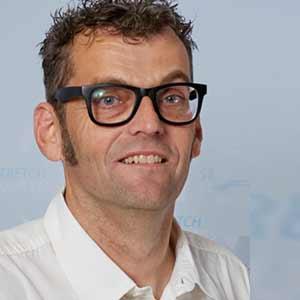
Exactly one year ago, food processing equipment manufacturer Marel installed a MetalFAB 3D metal printer in Boxmeer, the Netherlands. Jeroen van Oers, manufacturing director, talks about the benefits, which aren’t so much to be found in the technological domain but most of all lie in a revolutionary shift in thinking for engineers when designing parts and machines.
Jeroen van Oers starts off by saying, “3D metal printing is not intended to replace our other production techniques. Of course, if a cast part is not in stock, we can print that part in 3D, but that should be the exception rather than the rule. It’s called additive manufacturing, meaning it’s a completely different way of designing. It is a technology that begins with nothing. If you look at conventional production techniques, you start with a sheet of metal, weld things together, and only remove what you can’t use. But that makes the part often too heavy and plump because in many places there’s metal that is actually of no avail. If you are going to print a perfect copy of such a metal part, it is by definition much too expensive because you are melting together metal powder in places where it has no function at all. You really should avoid that.”
Additive – the art of omission
Jeroen van Oers continues, “In Lichtenvoorde, we manufacture a robot arm with two fast-moving cutting blades. The weight and height of that arm determine its required stiffness. So far, the original part has been made of solid metal. Stiffness, however, is created on the outside, so in principle, that arm can be hollow. That’s why we printed a hollow arm with a honeycomb structure. As a result, the arm only weighs 24% of its original weight without compromising stiffness or functionality. That printed part may be quite expensive, but if you look at the overall picture, it is a win-win situation. The movements of the robot arm are faster, the service life is longer, the wear on parts is less, and therefore, the line downtime is less. That’s a huge profit.”
45 post-its
Jeroen van Oers talks about Marel’s decision to purchase a 3D metal printer, “We have collaborated with our partner Royal Kaak/K3D, a pioneer in the Dutch food industry. About seven years ago, they were the first users of Additive Industries’ MetalFAB printer. In 2019, I went into the factory with people from K3D and a few of our engineers and handed out post-its, saying, “If you see a part on these two machines that you can make better by 3D printing, stick a post-it on it.” Within no time, the two machines—of the 120 variants we are building here—were covered with 45 stickers. Then I knew enough: "We’ve struck gold.”
“Additive Industries has made the MetalFAB printer so reliable and safe that it can be used industrially. That is why now we have a system that we can use immediately in our real-world production environment without having to experiment first”
Additive Industries of Eindhoven is the Dutch manufacturer of the printer. The technology was actually invented 25 years ago. “Additive Industries has made the MetalFAB printer so reliable and safe that it can be used industrially. That is why Marel decided to invest in the development of this printer. As a result, we now have a system that we can use immediately in our real-world production environment without having to experiment first.”
Development phase
“3D metal printing is already very important for us during the development phase, to create functionality that doesn’t exist yet or to replace cast parts that we can’t acquire so quickly. In the development phase, it’s more convenient to print and refine. In the production phase, we can still decide to cast certain parts and continue to print the others.”
Curved holes
“I dare say that our application of the MetalFAB is leading in our industry. Of course, there are more 3D metal printers out there, but we really succeed in adding new functionalities to the machines we build, and we reach higher technological levels than ever before. An example can be found in a new Marel deboning machine, where a certain part occurs on all cones. It turned out to be much more efficient to create a curved hole at the blow-out point of that part. Previously, we could only drill straight holes, and the functionality to make such curved holes simply didn’t exist. The 3D metal printer allows us to apply technology we couldn’t realize before, making our food processing machines even more advanced.”
Eliminating limitations
“3D printing and the production techniques are wonderful. But I think the impact it makes on the way engineers start to think is revolutionary,” continues Jeroen van Oers. “Usually, a design engineer is consciously or unconsciously guided by the possibilities available to create a new part. Technology indicates the limits of what you can create.
An architect can only shrink the diameter of the pillars of a building to a certain extent because there is simply no material that can bear the load with sufficient stability. So designers always have to make concessions. When designing a food processing machine, it’s no different; you have to deal with the limitations of the production technology. If you know how to eliminate these limitations, you can create unique functionalities that solve problems that couldn’t be solved before. You can even create value that wasn’t there before, and that’s exactly what we’re doing now. The benefits of the 3D metal printer reach much further than just the new technology.”
“For years, we bought the parts that we now print because it seemed the easiest. But sometimes, we received a part that was crooked or not exactly what we wanted, and it was simply thrown away. This way of working clearly lacked dialogue.
In fact, the 3D metal printer is not the issue here. It’s about the moment when a new dialogue emerges between our engineers. They start sparring with each other, after which the 3D printer can print the first result the next day. That is already very close to perfection; only one more thing needs to be adjusted, after which the second print hits the bull’s eye. The value we create at that point is priceless, and this is precisely what happens here every day.”
A different way of thinking
“You definitely need visionary people to come up with new ideas. If you don’t know what’s possible, you can’t invent it. The main effect of the 3D printer is that it has changed the way engineers think,” concludes Jeroen van Oers. “The printing itself is simply a physical process. But our manufacturing engineer is now much more likely to say, "This might work," where he would have said before, "We’ll never manage to do that." What has changed is that we don’t think in terms of limitations anymore. In the end, it is not so much the investment in a 3D metal printer that gives us an advantage, but rather the investment in the thinking of our engineers. “If you don’t know what’s possible, you can’t invent it.”

Manufacturing Technology Insights Weekly Brief
Be first to read the latest tech news, Industry Leader's Insights, and CIO interviews of medium and large enterprises exclusively from Manufacturing Technology Insights
